
Updated October 2026. Steps checked against Washington State Department of Health guidance for pumped septic systems.
A septic alarm going off usually means the water in your pump tank is higher than it should be, most often because the pump isn’t running. Press the silence button, stop using water, and check whether the pump’s breaker has tripped. Your pump tank has reserve space that buys you time, typically enough for a repair if you keep water use low. If the light stays on after a few hours, call a septic professional.
What to do right now
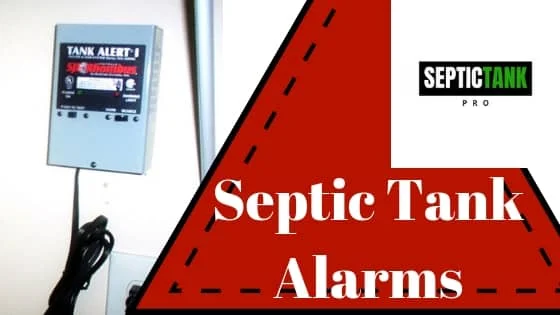
- Silence the alarm. Find the alarm box, often on an outside wall, a post near the tank, in the basement or a utility room, and press the silence or reset button. The buzzer stops but the red light stays on until the problem is fixed.
- Stop using water. Hold off on laundry, showers, baths and the dishwasher. The Washington State Department of Health says the reserve storage in the pump chamber should give you enough time to get the problem corrected if you conserve water.
- Check the power to the pump. Look for a tripped breaker or blown fuse, a tripped GFCI outlet, or an unplugged cord. Septic pumps and alarms are usually on separate circuits, so the alarm can have power while the pump does not. If a breaker tripped, reset it once.
- Give it a few hours. If the pump was simply behind after heavy use, it may catch up and the light will go off on its own.
- Call for service if it doesn’t clear, or if the breaker trips again. Washington State Department of Health guidance says pump and electrical repairs must be done by a licensed professional, and to never enter the pump chamber.
Alarm still on?
A septic pump or float problem needs a pro. Talk to a local septic company about a service call.
Calls are answered by a pay-per-call partner network that connects you with a local septic company. Calling is free; we may be paid for referrals.
Why septic alarms go off
Most alarms are high-water alarms. A float switch inside the pump tank tips up when the liquid rises past a set level and triggers the light and buzzer. These are the usual reasons, roughly from most to least common:
| Cause | What’s happening | What to do |
|---|---|---|
| Pump has no power | Tripped breaker, GFCI or unplugged cord | Reset once; call if it trips again |
| Heavy water use | Several loads of laundry or guests overloaded the tank faster than the pump runs | Spread out water use; the light should clear on its own |
| Heavy rain or high groundwater | Water is getting into the tank through a cracked lid, riser or pipe joint, or a soggy drainfield is draining slowly | Cut water use; have lids and risers checked and replace a cracked lid |
| Stuck or tangled float | The pump’s on/off float is hung up on a cord or debris | A septic pro can free it; don’t reach into the chamber yourself |
| Failed pump | The pump motor has burned out or is clogged | Pump repair or replacement by a licensed pro |
| Clogged effluent filter or line | Solids or wipes have blocked flow out of the tank | Pumping and filter cleaning |
| Aerator failure (aerobic systems) | On aerobic systems, a separate alarm warns that the air pump isn’t running | Check its breaker, then call your maintenance provider |
The Washington State Department of Health also lists floats tangled with other parts, or debris on the floats, among the simple things to check. Leave that check to your service provider unless you know your system well.
Which septic systems have alarms?
Any system with a pump or an air blower should have one. A basic gravity system, where wastewater simply flows downhill from the tank to the drainfield, doesn’t need a pump and often has no alarm. Alarms are standard on:
- Mound systems and other systems that pump effluent uphill or into a raised drainfield
- Pressure-dosed and drip distribution systems
- Aerobic treatment units, which often have both a high-water alarm and an aerator alarm
- Homes with a sewage ejector pump in the basement
If you are not sure what you have, here is whether a septic system needs electricity, and how a septic system works.
How to test your septic alarm
Most alarm panels have a test switch or button. Flip it, and the light and buzzer should come on; flip it back and they should stop. Testing a few times a year, and whenever your system is serviced, makes sure the alarm will actually warn you. If nothing happens, check the alarm’s breaker and replace the panel or call for service.
Quick answers
Can I just turn the septic alarm off?
You can silence the buzzer, but don’t cut power to the alarm or ignore the light. Without it, the first sign of a pump failure may be sewage backing up into the house.
How long can I use water after the alarm goes off?
It depends on the size of your pump tank’s reserve and how much water you use. Keep use to the bare minimum, such as flushing toilets sparingly, and get the problem fixed the same day if you can.
Why does my septic alarm go off when it rains?
Rain or high groundwater is leaking into the tank, usually through a cracked lid, a loose riser or a bad pipe joint, or a saturated drainfield is slowing down. Cut water use until it dries out, then have the tank checked for leaks.
Why does the alarm go off and then stop on its own?
The pump may be catching up after heavy use, or a float may be sticking. Repeated short alarms are worth a service call before the pump fails completely.
Does a septic alarm mean my tank needs pumping?
Not usually. The alarm watches the pump tank level, not the sludge in your septic tank. Still, if it has been more than 3 to 5 years, the EPA’s usual pumping interval, have the tank checked at the same visit. See how often to pump a septic tank.
Need a local company? Use our septic company directory, or read more in who to call when your septic alarm sounds.
Sources
- Washington State Department of Health, Understanding and caring for your mound system (PDF, checked October 2026)
- U.S. EPA, How to care for your septic system